Spanish Mackerel | How to recognize and catch them!
The Spanish Mackerel is one of Florida’s most exciting inshore fish: fast, aggressive and often traveling in large schools. If you see birds circling over the water, small baitfish fleeing on the surface or sudden splashes off beaches, piers, passes or piers, you have a good chance of catching this lightning-fast predator.
Spanish Mackerel – The most important facts in brief
Occurrence & top spots in Florida
The Spanish Mackerel is found on both coasts of Florida – in the Gulf of Mexico as well as on the Atlantic coast. It lives close to shore, in open water, over seagrass beds, on reefs, in bays and occasionally in shallow estuaries. Good fishing spots are beaches, piers, jetties, inlets, passes and areas with lots of small baitfish.
Best time to fish for Spanish Mackerel
Spring and fall are particularly productive, when schools of migrating baitfish move along the coast. In South Florida, the Spanish Mackerel often remains active longer, while in North Florida it is less common in winter. Early mornings, late afternoons and running tides offer good opportunities.
Fishing methods & requirements
- Method: Spinning or baitcast rods, light to medium saltwater combo, about 10-20 lb braid, plus 20-30 lb fluorocarbon or a short, thin steel leader if there are a lot of bites
- Technique: Cast fast and retrieve quickly.
- Tip: Early mornings, late afternoons and running tides are particularly successful. If you fish from a boat, you can actively search for shoals. From the pier or beach, it is always worth having a ready-mounted rod to hand, as the feeding phases often only last a few minutes.
Spanish Mackerel – Swarm fish fast and agile
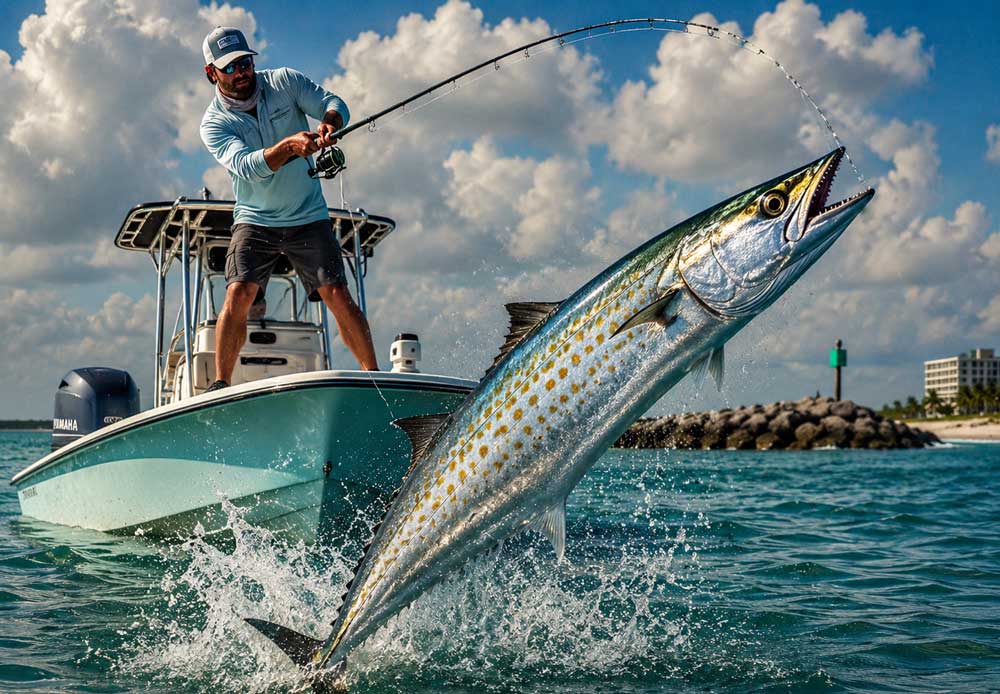
For vacationers, the Spanish mackerel is particularly attractive because it can be caught not only from a boat, but often also from the beach or fishing pier. It fights hard, occasionally jumps out of the water and is easy to recognize with its silvery body and golden yellow spots.
The Spanish mackerel, scientifically Scomberomorus maculatus, belongs to the mackerel family and is related to the tuna. It is a typical predator of open coastal waters: fast, agile and specialized on small fish. NOAA lists open waters, deep seagrass beds, reefs and shallow estuaries as its main habitat. Water temperatures above about 68 °F are preferred.
Spanish mackerel often hunt in shoals. When they drive small fish to the surface, short, intense feeding phases occur. This is ideal for anglers, but also challenging: the shoal can disappear again in a matter of minutes. This is why long casts, fast baiting and a watchful eye on the water surface and seabirds are crucial.
Their diet consists mainly of small fish, as well as shrimp and squid. The fish spawn offshore from spring to summer.
The Spanish mackerel is popular as an edible fish, but should be eaten as fresh as possible. The meat is more aromatic and richer in oil than that of many white reef fish. If you take it with you, you should chill it immediately and not leave it in the warm Florida climate for an unnecessarily long time.
This is what she looks like
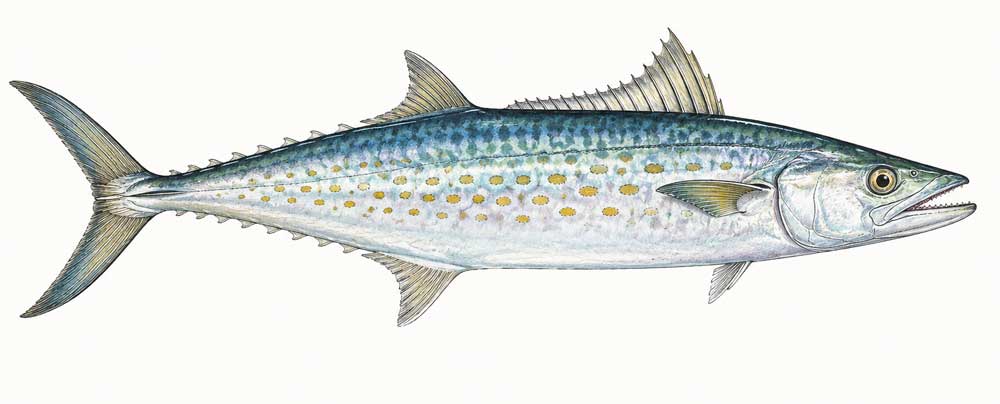
The Spanish Mackerel has a long, slender and streamlined body. The back is blue-green to steel-blue, the flanks are silvery light. The most striking feature is the yellowish-golden, oval spots along the sides of the body. These spots clearly distinguish them from many other Florida coastal fish.
Also typical are:
- a pointed head with a large eye,
- a narrow mouth with sharp teeth,
- a deeply forked caudal fin,
- small fins behind the dorsal and anal fins,
- a very slim physique.
Important to differentiate: Unlike the Snook, the Spanish Mackerel has no black sidelines. It looks more like a small, very fast deep-sea hunter in coastal format.
How do I catch a Spanish Mackerel?
It is best to look for the food first, not the fish. Where sardines, glassfish, anchovies or other small fish flee to the surface, Spanish mackerel are often not far away. Good clues are diving birds, sudden splashes, small swirls of water on the surface or chasing fish directly behind the surf zone.
Suitable device:
- Spinning rod about 7 ft, medium-light to medium,
- 2500 to 4000 mm reel,
- 10-20 lb braided line,
- 20-30 lb fluorocarbon or mono leader,
- short, thin steel leader for many bites.
Proven lures are silver spoons, small metal jigs, Gotcha plugs, slim small fish plugs, small rubber lures and live baitfish. The decisive factor is usually a fast, escaping lure presentation. Spanish mackerel react strongly to speed and reflexes.
Good spots are piers, jetties, inlets, passes, beaches with schools of baitfish, seagrass beds, nearshore reefs and channel edges. Early in the morning, late in the afternoon and when the tide is running, the chances are particularly good.
Be careful when retrieving: the teeth are sharp. Do not reach into the mouth, but use tongs or a dehooker. If you release fish, you should unhook them quickly and not keep them out of the water for long.