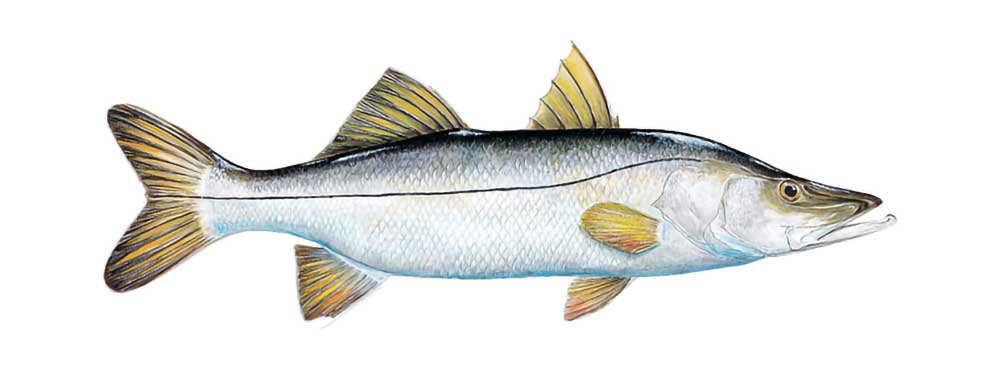
Snook | Divided dorsal fin and black lateral line
The snook swims in the coastal waters of the east and west coasts of Florida, the coast of Texas and as far south as Brazil. It is primarily a saltwater species, but also occurs in fresh and brackish waters adjacent to the coast. The snook is a genus of true perch.
Snook – The most important facts in brief
Occurrence & top spots in Florida
Snook do not live offshore, but in shallow, warm coastal waters. They feel particularly at home in mangroves, estuaries, canals and under bridges – especially on the west coast of Florida. Top spots for fishing include: Tampa Bay, Ten Thousans Islands, Charlot Harbor/Punta Gorda, Jupiter Inlet & Sebastian Inlet as well as Miami & Fort Lauderdale.
Best time to fish for Snook
The main season is in March-May and September-November. During these months, the water temperatures are ideal and the fish are particularly active. Please note: Regional closed seasons and fishing restrictions apply in Florida, e.g. snook may only be fished with catch & release or not at all in certain months.
Fishing methods & requirements
- Method: Spinning or baitcast rods, 20-30 lb braid, use of artificial lures (jerkbaits, topwater, softbaits) or live bait such as pinfish or shrimp
- Technique: Targeting structures such as mangroves, piles, docks – especially at high tide or at dusk
- Tip: Many local guides offer targeted snook tours at night, e.g. around bridges or dock lights. This gives you a good chance of a real drill experience, even as a beginner.
Snook – Coastal hunter with character
 Snooks love the coastal waters, mangroves and canals.
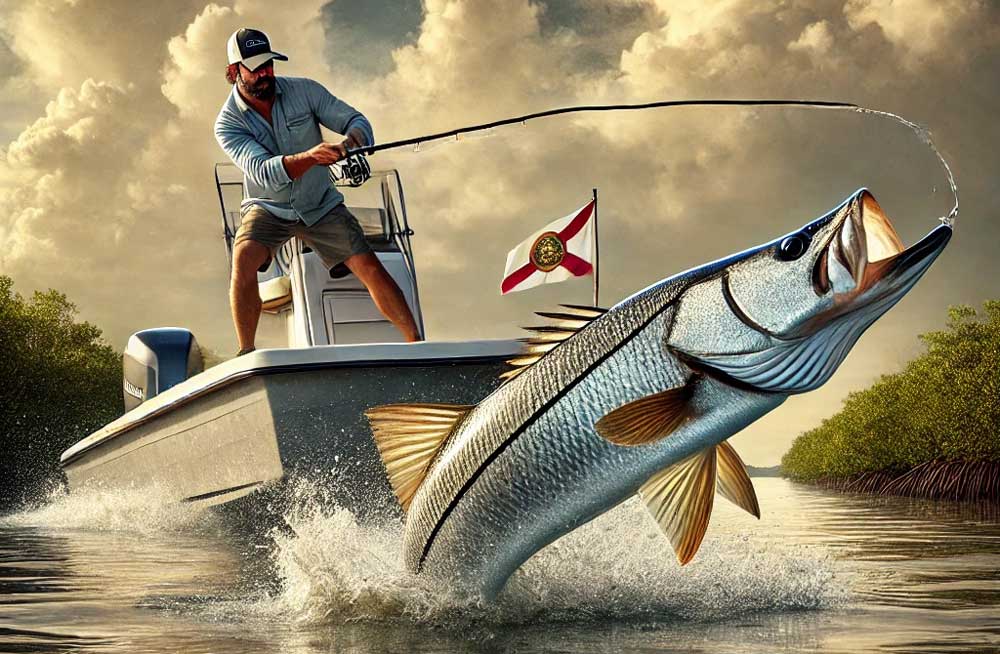
The snook is one of the most popular target fish in Florida – not because of its size, but because of its temperamental behavior and exciting fishing technique. Anyone who has ever seen it in action will understand why this fish is so revered. Its streamlined body with the distinctive black side stripe is striking – a sure way to recognize it, even in murky water.
Typical of the fish are its lightning-fast escapes, daring jumps and the targeted use of obstacles such as mangrove roots, jetties or bridge piers. Anyone who is unprepared or uses tackle that is too light will quickly lose out.
Especially in the warmer months, snook are attracted to shallow brackish water zones, estuaries or artificial structures. The chances are best early in the morning and at dusk – this is when the predators go hunting for small fish or shrimp. The use of artificial lures such as jerkbaits, rubber fish or topwater lures has proven just as effective as fishing with live bait.
The best fishing times are in spring and fall. However, predatory fish are subject to strict regulations in Florida. Catch restrictions, slot limits and closed seasons are regulated regionally – so you should always check the current regulations before fishing. Violations can be expensive.
Male becomes female
Interesting fact: The grouper-like predatory fish is a protandric hermaphrodite – it is first born as a male and later develops into a female. This biological peculiarity makes sustainable management all the more important.
Anyone looking for the thrill of inshore fishing will find the perfect opponent in the snook: challenging, wild and unpredictable. It is not without reason that it is considered the king of the mangroves – and a real touchstone for sport anglers in Florida.
Snooks usually weigh from 1.5 to 7 kg (3 to 15 pounds). However, there are also fish weighing 9 to 14 kg (20 to 30 pounds). Only a few exceed the 18 kg (40 pound) size and the Florida record is 20 kg (44 pound, 3 oz). Female snook grow up to 1.2 m (48 inches) and males up to 1 m (39 inches).
This is What it Looks Like
The long silver body, the light olive-brown coloration on the back, the divided dorsal fin, the yellow ventral fin, the large mouth with protruding lower jaw characterize the snook. Its body shape is similar to that of the freshwater pikeperch.
The biggest distinguishing feature from similar fish is the single black lateral line from the gills to the caudal fin.
How do I catch a snook?
Snook are one of the most sought after inshore dolphinfish because they bite on a variety of baits such as live pilchards, shrimp and crabs, mullet heads and numerous types of artificial lures. Their habitats are grass, bays, sandbars, bridges, beaches and mangroves. Local regulations should be observed when snook fishing.
Especially in the warmer months, the fish are drawn to shallow brackish water zones, estuaries or artificial structures. The chances are best early in the morning and at dusk – this is when the predators go hunting for small fish or shrimp. The use of artificial lures such as jerkbaits, rubber fish or topwater lures has proven just as effective as fishing with live bait.
Important: If you want to fish in Florida, you need a Saltwater Fishing License. This is usually included in the price of guided tours.