Sheepshead | zebra stripes and sharp fins
The Sheepshead is a species of bream and swims in the 20 to 28°C warm coastal waters of the Gulf of Mexico, the western Atlantic, the Caribbean and Central and South America. The saltwater fish can be found in areas with rocky bottoms, docks, bridges, piles, artificial reefs and mangroves.
Sheepshead – The most important facts in brief
Occurrence & top spots in Florida
Sheepshead prefer to live in coastal waters with hard structure – e.g. on rocks, piers, bridge piers, harbor walls and oyster beds. They are particularly common on Florida’s west coast, for example in Tampa Bay, near Sanibel/Captiva, Pine Island, Apalachicola or Cedar Key. Channels in Cape Coral are also very promising.itfish.
Best time to fish for Sheepshead
The main season is from December to April, when the fish migrate close to the coast to spawn. This is when they are particularly numerous and easy to catch. In summer, they retreat further into open water or deeper channels.
Fishing methods & requirements
- Method: Light to medium spinning rod, 10-20 lb fluorocarbon leader, small circle hooks (size 1-2/0)
- Bait: Fresh crabs, shrimps, sand fleas or mussel meat – hard bait stays on the hook better
- Technique: Direct fishing on vertical structures, very fine bite feeling required – often only a short pluck
- Tip: Sheepshead have strong teeth and crack shells – setting the hook requires good timing. Ideal when the tide is rising in harbor areas and bridges.
Sheepshead – More zebra, less sheep
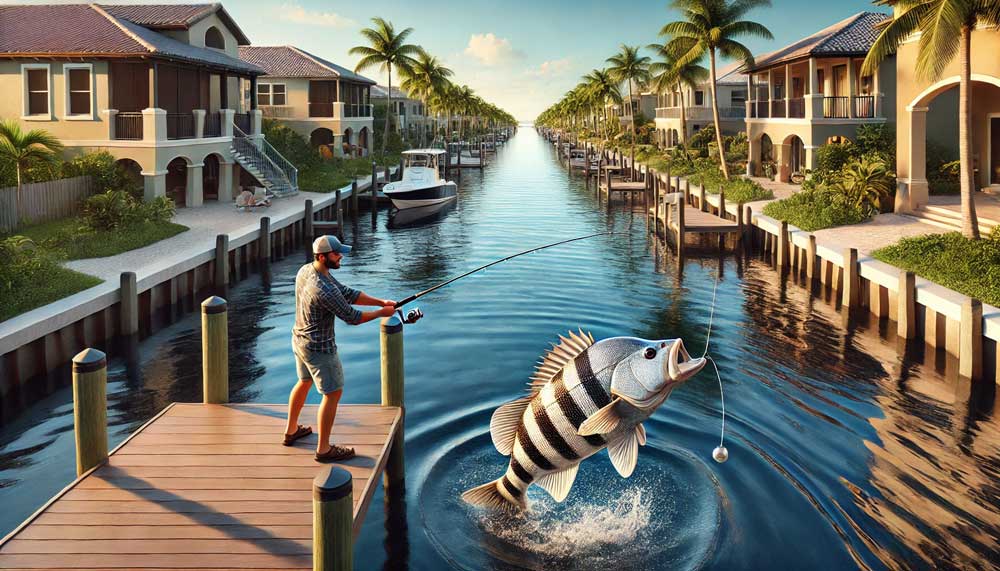
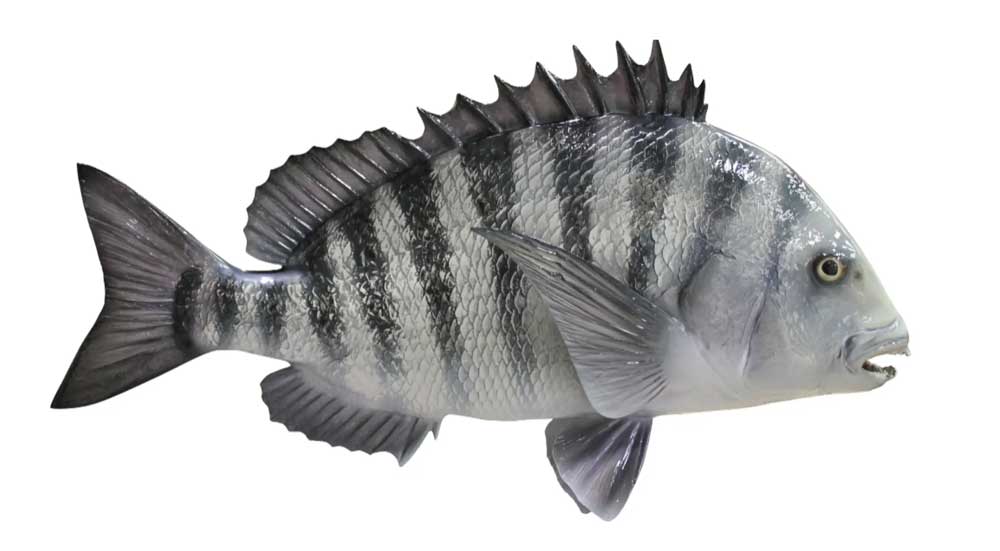
The body of the Sheepshead (Archosargus probatocephalus) is predominantly striped on a partially yellowish background. Its dorsal and anal fins are heavy and sharp. The only fish to confuse them is the Black Drum.
Sheepsheads usually weigh between less than 0.45 kg (1 pound) and 1.8 kg (4 pounds). Occasionally they can be found weighing 2.3 kg (5 to 7 pounds). Fish of up to 4.5 kg (10 pounds) are rare and are taken annually in late winter and spring in North Florida, mainly in inshore wrecks and navigation markers. The Florida record is just under 7 kg (15 pounds, 2 oz).
Thanks to its shellfish diet, the sea bream is one of the best edible fish. It is not an aggressive fish to catch, which can be done with light fishing. Fresh small crabs, live or fresh dead shrimps, oyster parts and mussels are suitable bait for the Sheepshead. The Sheepshead has powerful jaws and strong teeth with which it bites the bait from the fishing hook. This makes it difficult for humans to catch.
This is What it Looks Like
The convict sea bream is a compact fish with a very flattened lateral shape and a high dorsal profile. It usually reaches lengths of between 30 and 50 cm, with large specimens up to 75 cm. Its most striking feature is the vertical black stripes on a silvery-grey background – usually 5 to 7 stripes each – which has earned it the nickname “prison fish”.
The head is high and massive, with a small but powerful mouth. Its human-like teeth are particularly striking: chisel-like at the front for cracking shells, roundish grinding teeth at the back – perfectly adapted to a diet of mussels, crabs and sea urchins. The name “Sheepshead” is also derived from the tooth-like structure, which is said to be reminiscent of a sheep.
The eyes are relatively large, with a dark iris. The dorsal fin is elongated, with strong hard rays at the front. The anal fin is significantly shorter, but also spiny. The pectoral fins are relatively broad, the tail slightly forked.
Despite its rather inconspicuous colors, the Sheepshead is immediately recognizable thanks to its striped pattern and unusual teeth – ideally camouflaged in habitats rich in structure such as oyster beds, rocks or piers.
How do I catch a Sheepshead?
Fishing is usually done from a jetty, quay or boat with light to medium-weight equipment: A 10-20 lb spinning or baitcaster rod with a sensitive tip, paired with a robust saltwater reel and 20-30 lb braided main line, ensures a precise feel for the lure and sufficient power during the fight. A 15-25 lb fluorocarbon leader is recommended to withstand sharp-edged structures such as oyster beds or bridge piles.
Basic rigs such as the Carolina Rig or simple dropper rigs with small but stable circle hooks in sizes 1 to 2/0 are used. As Sheepshead are known for their cautious bites, a sensitive presentation is crucial – hooks that are too large or flashy rigs often lead to nothing.
Hard, natural delicacies are particularly suitable as bait: small crabs (e.g. fiddler crabs), fresh or salted prawns, mussel meat, oysters or sand fleas. It is important that the bait sits firmly on the hook – Sheepshead are notorious bait thieves and often nibble it off skillfully without getting caught.
The technique is simple, but requires patience: fish just above the bottom, preferably directly on structures such as bridge piers, jetties, dock piles or rocky stretches of coastline. The bite often only manifests itself as a short tug or jerk. Therefore: strike immediately at the slightest movement.
The best fishing times are in the cooler months between December and April, preferably when the tide is rising and the water is slightly murky. The chances of success are particularly high in the morning and late afternoon – especially in places with strong currents and mussel growth.