Mullet – Florida’s jumping coastal fish
The mullet is one of Florida’s best-known fish and is encountered by anglers, boaters and holidaymakers almost everywhere along the coast. Especially in canals, harbors, mangroves or on beaches, the silvery shoals often pass by. For many predatory fish such as snook, tarpon, redfish or jack crevalle, mullets are their absolute favorite prey. This is why they also play an important role in fishing.
Mullet – The most important facts in brief
Occurrence & top spots in Florida
Mullets can be found along practically the entire coast of Florida. They are particularly common in canals, mangroves, estuaries, harbors and on beaches. Good places to observe them are Cape Coral, Tampa Bay, the Ten Thousand Islands, Sarasota and the Atlantic coast around Jupiter and Sebastian Inlet.
Best time to fish for Spanish Mackerel
Mullets can be found in Florida all year round. However, the so-called “Mullet Run” is particularly spectacular in the fall between September and November, when huge shoals migrate along the coast and attract numerous predatory fish.
Fishing methods & requirements
- Method: Cast net, light spinning rods or simple float mounts with small hooks and bread, dough or natural bait
- Bait: Bread, dough or small natural baits sometimes work well
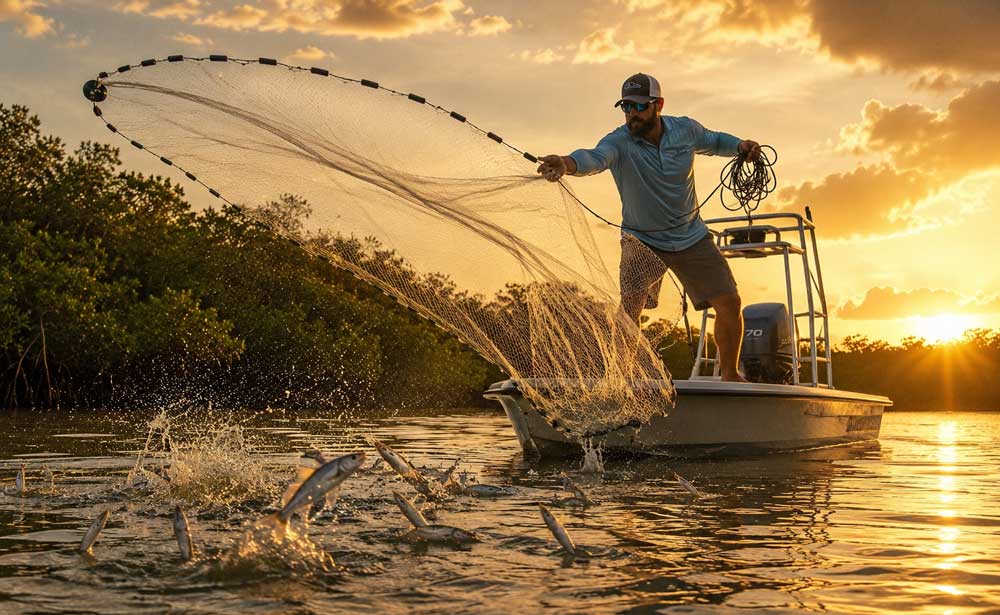
- Technique: Throwing the cast net over visible shoals in shallow channels, docks, mangroves or shore areas – especially early in the morning or in the evening when the water is calm
- Tip: Fresh Mullets are among the best natural baits for snook, tarpon and large redfish
Mullet – Florida’s silver schooling fish
If you’re sitting by the canal in Cape Coral in the evening, for example, you’ll hear a splash here and there, often several times in succession. If you hear this, it is almost certainly muletts. Why they jump so much is not fully understood scientifically. But there are several plausible explanations:
- Many biologists assume that mullets want to reduce sludge, parasites or oxygen deficiency in the gills by jumping.
- As mullets almost always travel in schools, jumping could also be used for orientation or communication within the flock.
- If the shoals are hunted by snook, tarpon, jack crevalle or dolphins, mullets often jump out of the water in panic at the same time.
- This behavior is particularly common in warm, low-oxygen water, which is typical for Florida in summer.
It is noticeable that mullets are particularly active in the evening and early in the morning . This is when you often see whole flocks shooting through the air at the same time – a typical sight in Florida’s canals and mangrove areas.
The most common representative in Florida is the Striped Mullet (Mugil cephalus), also known as the Grey Mullet. Despite its rather inconspicuous appearance, it is one of the most important bait and prey fish in the Sunshine State. At the same time, it is also considered an edible fish in many regions of the world and is often offered as smoked fish in Florida’s waterfront restaurants .
The fish usually move around in large schools and often jump spectacularly out of the water. Large schools of mullet are easy to observe, especially in the mornings and evenings. Mullets feed mainly on algae, organic material and microorganisms at the bottom of the water. Unlike snook or tarpon, they are not classic predators. They use their small mouths to filter food from mud, sand and plant debris.
Their schooling behavior is typical. Hundreds of animals often move through shallow waters at the same time – an important reason why predatory fish regularly follow them. Where there are many mullets, snook, redfish or tarpon are often not far away.
Mullet Run – The big fall spectacle
The so-called mullet run is particularly well-known in Florida. In the fall, huge schools of mullet migrate south along the coast. This natural spectacle attracts countless predatory fish and is considered one of the best fishing seasons of the year.
Especially on beaches, inlets and bridges, there are often spectacular hunting scenes with jumping tarpon, snook or jack crevalles in the middle of the schools of mullet.
This is what a Mullet looks like
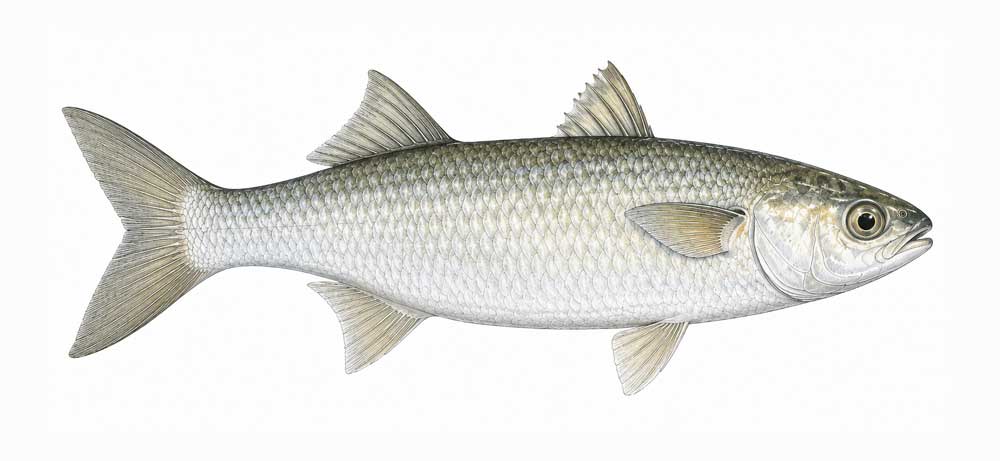
Mullets have an elongated, torpedo-shaped body with a strong tail base. The coloration ranges from silver-grey to olive, while the ventral side usually appears much lighter. The dark, horizontal lines along the flanks are characteristic. This is where the name “striped mullet” comes from.
The head appears blunt and rounded, the small mouth is relatively deep and is adapted to foraging on the bottom. Unlike typical predatory fish, mullets do not have large fangs. The eyes are strikingly large and often slightly yellowish in color.
The dorsal fins are widely separated: a small hard-rayed dorsal fin at the front and a second soft-rayed fin behind it. The caudal fin is strongly forked and allows for quick escapes in large shoals. The scales are particularly shiny when exposed to sunlight.
How do you catch a Mullet?
Mullets are usually caught in Florida with a cast net. Especially in canals, marinas or on shallow stretches of coastline, the shoals can often be seen right on the surface. Good times are early in the morning or in the evening, when the fish move close to the shore.
Alternatively, smaller mullets can also be caught with light float or bottom rigs. Pieces of bread, dough or small natural baits are suitable as bait. As mullets are not aggressive predators, they require a little patience and a rather delicate presentation.
Many anglers then use fresh Mullets directly as bait fish – either live or as fillets. Large snook, tarpon and sharks in particular often respond very well to mullets.